
Start with completed sales of land like yours, then check what each sale included. Martin County keeps property records and sales information, but a change of owner is not always an ordinary sale. Use the records to find examples and ask a local land agent which ones make sense for your land.
Start with the assessor’s property and sales records
The Martin County Assessor’s page says the office keeps property records and county-wide sales information. It links to Elevate, where you can view parcel data and print property record cards.
A parcel is a piece of land with its own county ID. Keep that number, the location and acres together. Check that the record describes the land you plan to sell.
The record card includes property details and an assessed value used for taxes. Keep that value separate from a completed sale price or a buyer’s offer.
For a missing recorded deed, start with the Martin County Recorder’s page. It points to DoxPop for online documents. A deed is the paper used to transfer ownership. Ask what copy you need and what access or copy costs apply before ordering.
You can begin with a tax bill or the owner’s name if you do not have every paper. Ask the office for help matching the record rather than guessing.
Ask whether money changed hands
A recorded transfer tells you something changed. It does not, by itself, tell you that an unrelated buyer paid a market price.
The Martin County Auditor’s page describes a sales-disclosure waiver for transfers without payment or other value given in return. It also says deeds must include all parcel numbers. Those are useful reminders when checking a possible comparison.
Ask the assessor or a land agent: Was this an ordinary sale? Was it a gift, a family transfer or another kind of change? Which document shows the price and all the land included?
Set aside a transfer with no clear sale price until you understand it. Do not count it as a zero-dollar market sale. Keep the deed reference and date so you can return to it later.
You do not need to learn every recording rule to sell. Your next step is to find a few clear comparisons, with help where needed.
Compare the ground, entrance and land included
Ask a local land agent for completed sales that fit your property. For each one, ask why it is useful and where it differs.
- Compare similar areas and sizes.
- Keep vacant land apart from land sold with a home.
- Note open ground, wooded slopes and water features.
- Compare how a buyer reaches the land.
- Check known services, buildings and the sale date.
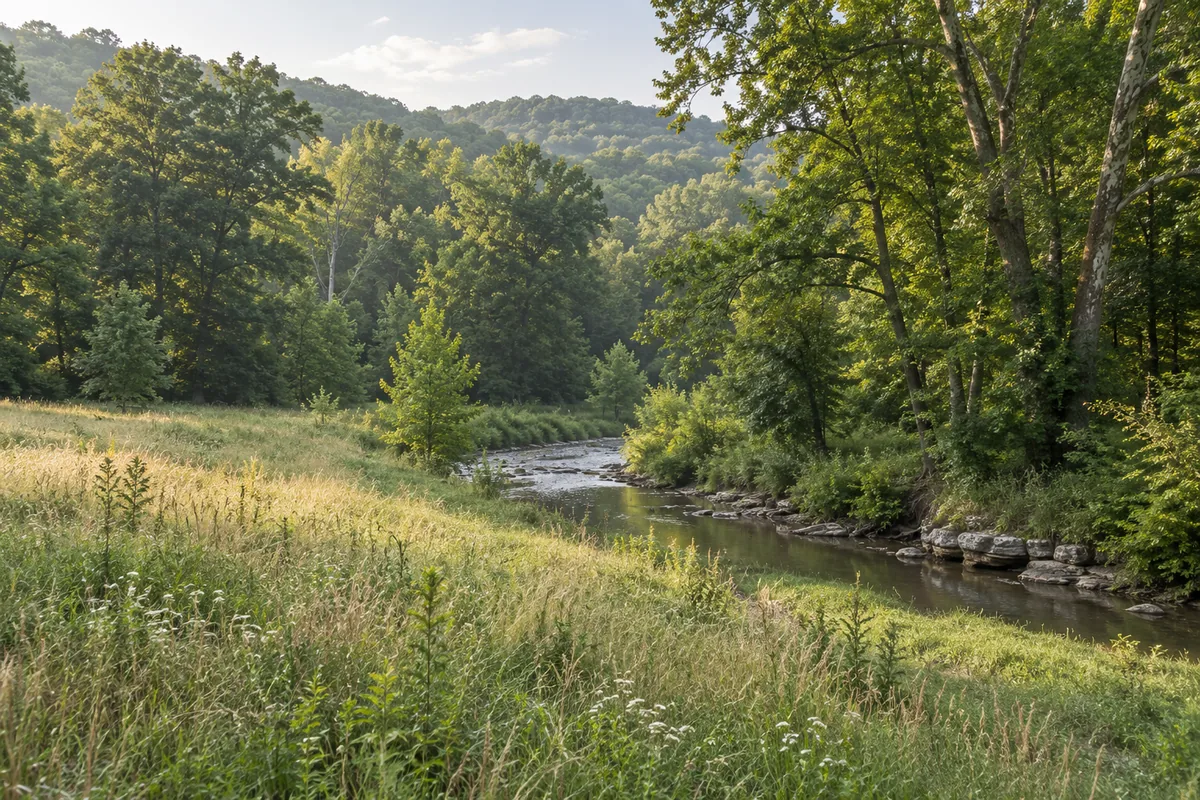
A creek-side meadow may differ from a steep wooded piece. Being close on a map does not make two properties equal. Describe what you know without promising road, water or building rights.
If close matches are scarce, ask about older sales or a wider area. Keep the dates and differences clear. A range with reasons is more useful than one precise number based on poor examples.
Keep the full price with all the acres
Make one note for each possible sale: parcel IDs, deed reference, date, price, total acres and buildings. If several pieces sold together, check the whole sale.
Here is a made-up example: a 9-acre piece and a 6-acre piece sell together for $90,000. The total is 15 acres, or $6,000 per acre. Dividing by only 9 acres gives a misleading result. This is math, not a Martin County sale or price estimate.
Two addresses or repeated listing rows may describe one sale. Check parcel and deed references before counting them separately.
A home sale is also different from a vacant-land sale. Subtracting a building’s tax value does not prove what the land sold for. Ask for a better match.
Gather a few things before talking with buyers
Keep a recent tax bill, survey, any lease and written road agreements handy. A survey is a drawing of land lines. Note the entrance, acres and questions you still have.
Share photos if it is safe to take them. You do not need to clear trees or buy a new survey just to start. Ask what would help before spending money.
If you’re handling inherited land or helping settle a loved one’s estate, gather the papers you have. Ask a closing professional who needs to sign before setting a firm date.
You can work with an agent, sell yourself or compare a direct buyer’s offer. An agent can help with pricing and ads. Selling yourself means handling more calls and visits. With a direct buyer, ask what they still need to check and what costs you pay.
Compare the money you keep and the rules in the offer
Write down each offer’s price, costs, loan payoff, taxes, deposit and target date. Ask when the buyer can cancel and which checks remain.
In a made-up example, $80,000 less $6,000 in costs leaves $74,000 before loans and taxes. An offer of $78,000 with $2,000 in costs leaves $76,000. These are examples, not local prices or Reelvest offers.
Get help with the written agreement. Before signing the final papers, confirm how payment will reach you. Use our offer worksheet or Indiana land seller guide.
If you would like a direct offer to compare, tell Reelvest about your land. Start with what you know.
Questions About Martin County Land Value
Does every recorded transfer show a market sale?
No. Martin County describes a waiver for transfers without payment or other value in return. Ask what kind of transfer it was and which papers show a useful sale price.
Where can I find a Martin County property record card?
The assessor’s page links to Elevate for parcel data and printed property record cards. Use the parcel number and location to check that the record matches your land.
Can I use the assessed value as a buyer’s offer?
No. It is used in the tax system. Compare suitable completed sales and the actual terms a buyer offers.
Are the old March 2026 tables verified land prices?
No. The saved rows lacked parcel and deed IDs needed to check separate completed sales. They were replaced with practical comparison steps.
Local source links reviewed October 6, 2026.