
Start with a recent tax bill, the county and the land’s ID number. Add any deed, survey or loan papers you already have. You don’t need a perfect folder to talk with an agent or buyer. Use this checklist to keep track of what you’ve found and what you still need help with.
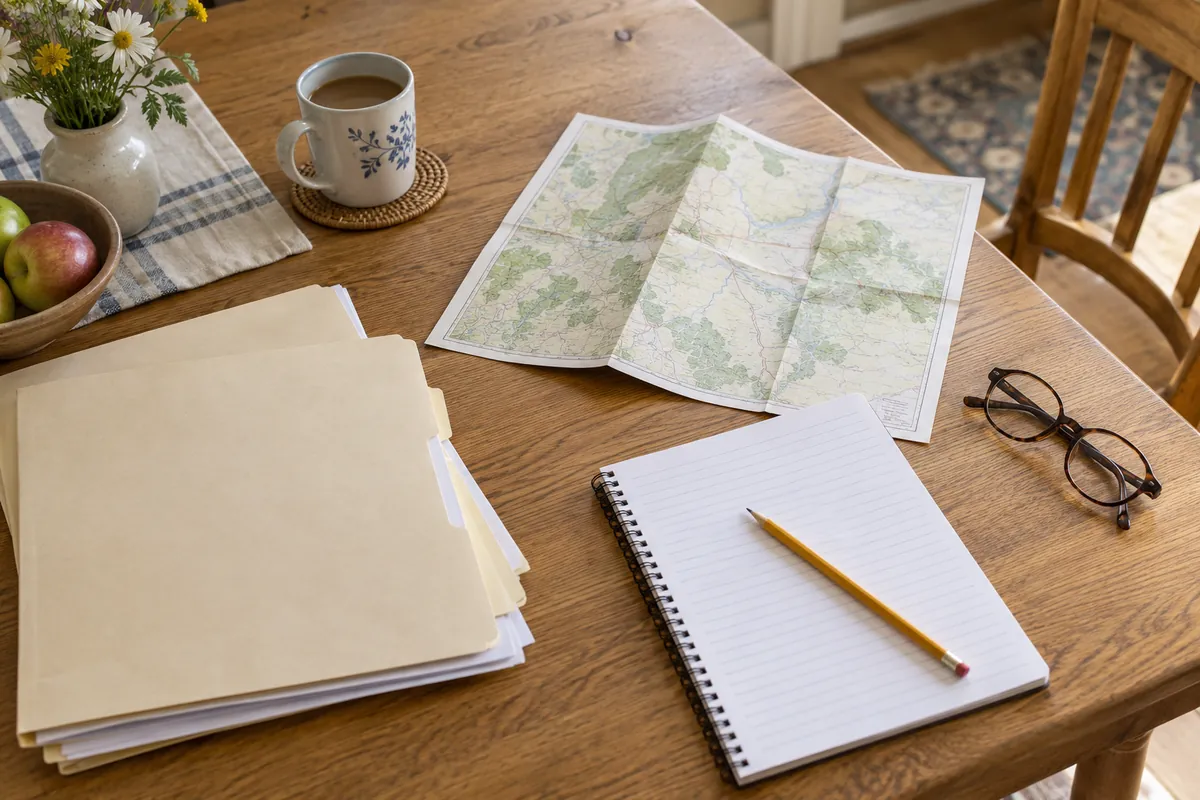
Gather what you have now
Keep one folder for each piece of land. If a paper is missing, write “need help finding it.” Leave room for questions instead of guessing.
Check these boxes as you go. These checks aren’t saved after you leave and aren’t sent with the contact form. You can copy the list onto paper.
This is a starting list, not a list of every paper needed to close a sale. The person handling closing can explain what your sale needs.
Start with the tax bill
A tax bill can help identify the land. Look for the county, owner name and parcel number, property ID or account number. Those labels aren’t always the same, so copy the label along with the number.
Keep any zeros at the start. If you own several pieces, don’t mix their bills or sizes. An old bill can be a useful clue, but it doesn’t show today’s loan balance or prove that all taxes are paid.
No street address? That’s common with vacant land. Our no-address guide shows how to start with county records. Don’t make up an address to fill a blank.
If the deed is missing
A deed is the paper used to transfer land from one owner to another. Look with the papers from when the land was bought or inherited. A family folder may have an older copy.
If you can’t find it, ask the county office that keeps recorded land papers. It may be called the recorder, clerk or register of deeds. Tell them the county, names you know and any land ID you found. Ask how to search and get a copy.
For a local example, Boulder County’s Recording Division links to recorded documents and copy requests. Your own county may use a different search. A deed copy helps the closing team start its work; it doesn’t replace their check of current ownership.
Keep maps and agreements together
A county map helps show where the land is. A survey is a drawing made by a surveyor. Keep an old survey if you have one. Don’t order a new one just to fill this checklist; ask what is needed for your sale first.
Write down how you reach the land. If you have papers about using a road, keep them nearby. A line on a map doesn’t prove the boundary or your right to use a road.
Also keep any lease, loan statement or written agreement about the land. For example, a farmer may rent the field or a neighbor may use a road. Say what you know, and mark what you don’t know.
If you’re helping with family land
If you’re handling inherited land or helping settle a loved one’s estate, start with the same short list. You don’t need to explain private family details in a website form.
Make a note of who is helping and what papers you already have. Ask the closing team who needs to sign and what papers show that. Don’t assume one person can sign for everyone because they pay the tax bill.
If several pieces are involved, make one line for each county, land ID and rough size. Our guide to selling several pieces of land can help keep them apart.
Ask these questions before closing
- Which missing papers do you need, and who will get them?
- Who needs to sign the sale papers?
- What loans, taxes or other charges will be paid from the sale?
- Who pays each fee, and how much money will I receive?
- When will the money be sent, and what could delay it?
If you have a loan, ask for the amount needed to pay it off for the planned date. That may differ from the balance on a statement. The CFPB explains why a mortgage payoff can include interest and other charges. Ask your lender or closing team for your actual figure.
Use our offer worksheet to compare the money you may keep. Mark unknown costs as unknown; don’t silently count them as zero.
Keep the first message simple
You can use this list with an agent, a buyer or the person handling closing. For a first conversation, give the county, land ID or location clue, rough size and what you’re hoping to do.
For example: “I have about eight acres near Pine Road. I found the old tax bill, but I need help finding the deed. I’d like to compare selling choices.” This is a made-up example, but it shows that a short note can be enough to start.
Want a direct offer to compare? Tell Reelvest about your land. Keep bank details, Social Security numbers and ID photos out of the website form.
Common paperwork questions
Do I need every paper before I talk to a buyer?
No. Start with the county, land ID or a location clue and what you know. Tell the buyer which papers are missing. Ask the closing team what is needed before the sale can close.
Does a tax bill prove I can sign the deed?
No. It can help identify the land, but the closing team needs to check ownership and who can sign.
Should I pay for a new survey first?
Ask what your sale needs before ordering one. Keep any survey you already have, and mention boundary questions early.
Local source links reviewed October 5, 2026.